
If you had the chance to accurately assess your cancer risk, what actions would you take?
With advancements in genetic testing, this inquiry has transformed into reality for a growing number of people. For sisters Colleen Greller and Katie Hernandez (formerly known as Kickel), the choice to pursue genetic testing changed their lives forever. Together, they are now committed to making the testing process more affordable and accessible for everyone.
Colleen and Katie recognized early on that their cancer risk could be heightened after the loss of an aunt to ovarian cancer in 2000. A routine mammogram in 2017, which revealed three irregular areas, confirmed those anxieties. Dr. Michael Schultz, Katie’s physician, recommended additional genetic testing to check for a BRCA1 genetic mutation. The results came back positive – empowering Katie to take action. She underwent a radical bilateral mastectomy (with immediate reconstruction) and bilateral salpingo-oophorectomy (BSO).
For the Kickel sisters, Katie’s discovery and swift, effective treatment plan brought immense relief. However, in 2020, as the world began to shut down due to COVID-19, Colleen learned following a preventive hysterectomy that she had stage 1 ovarian cancer. During the procedure at University Hospitals, Dr. Kristine Zanotti was able to customize Colleen’s examination due to her awareness of the family’s BRCA mutation history. Today, both Katie and Colleen are free of cancer.
Many individuals affected by ovarian cancer are not as fortunate to benefit from early detection – screening options remain notably limited. Nevertheless, when the risk level is identified through genetic testing, outcomes like those of the Kickel sisters become considerably more likely. Motivated by their experience, Colleen and Katie established a foundation to fund genetic testing for those facing financial obstacles. “I was having a conversation with my sister on the phone – I chat with her daily,” Colleen stated. “And I mentioned we need to take action regarding this genetic testing that has saved our lives. In that twenty-minute conversation, the concept of K.I.C.K. was conceived.”
Knowledge Is Cancer’s Kryptonite (K.I.C.K.) was founded in 2023 and has since facilitated genetic testing for over 300 patients across 48 states. By collaborating with genetic counselors, K.I.C.K. provides financial assistance for tests that enable patients to make informed choices based on their cancer risk.
Colleen shared her thoughts on facing the fear of knowing one’s risk. “The most important lesson I’ve learned is that my sister and I are here now and hopefully will grow old with our husbands and children because of this. Our aunt unfortunately didn’t have that chance. Learning about it can invoke a lot of fear, and I understand that, but knowledge can be transformative.”
Through their advocacy efforts, K.I.C.K. has partnered with OutRun Ovarian Cancer (OROC), a Northeast Ohio-based nonprofit focused on raising funds and awareness for ovarian cancer. To this date, OROC has collected over $2,000,000 since it started in 2003. Each year, OROC conducts events and fundraising activities that support survivors and honor the memories of those who have passed, notably during an annual 5K Run/Walk event in downtown Cleveland. OROC hosted its 22nd annual 5K Run/Walk on August 2nd, 2025, with more than 1,400 participants.
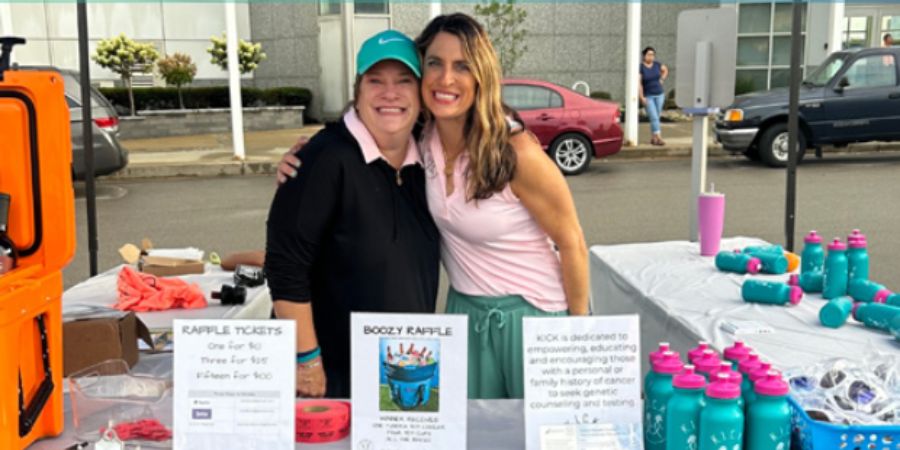
The missions of K.I.C.K. and OROC naturally align, and together they urge individuals with hereditary cancer risk to seek testing and gain power from their knowledge. Colleen and Katie attend the race every year, providing outreach and encouragement to survivors and their families present. At one of OROC’s 5K events, Colleen recalls being touched by a patient who traveled to thank her for the help she received from K.I.C.K. “It was an emotional moment for all of us,” she reflected.
**Supporting Families in Cancer Care: K.I.C.K. and OROC’s Role in Offering Knowledge and Assistance**
Cancer impacts not just the diagnosed individual but also their families, who often encounter emotional, logistical, and financial obstacles during the treatment journey. In response to these challenges, organizations such as K.I.C.K. (Knowledge, Information, Community, and Kindness) and OROC (Oncology Resource and Outreach Center) have emerged as crucial resources for families maneuvering through the intricacies of cancer care. This article examines how these entities empower families through education, support, and community engagement.
### Understanding K.I.C.K. and OROC
**K.I.C.K.** is focused on delivering crucial knowledge and information about cancer, treatment options, and coping mechanisms to families. The organization aims to establish a supportive community where families can exchange experiences, access resources, and find emotional backing. K.I.C.K. highlights the significance of kindness and empathy in the cancer journey, cultivating a feeling of belonging among families.
**OROC**, conversely, functions as a comprehensive resource center that connects families with healthcare practitioners, support services, and educational materials. OROC strives to simplify the process of accessing trustworthy information and assistance, ensuring that families can utilize the tools they require to make informed choices regarding the care of their loved ones.
### Providing Knowledge
A primary function of K.I.C.K. and OROC is to inform families about cancer. This encompasses information on various cancer types, treatment methods, side effects, and coping strategies. Both organizations provide workshops, webinars, and informational pamphlets that simplify complex medical terminology into palatable language. By equipping families with knowledge, they can better advocate for their loved ones and actively engage in treatment decisions.
### Emotional Support
Cancer can be a deeply isolating experience, significantly impacting families’ emotional well-being. K.I.C.K. and OROC create venues for families to connect with others encountering similar challenges. Support groups, available both in-person and online, offer families the chance to share their narratives, anxieties, and successes. These connections can mitigate feelings of isolation and foster a sense of community, essential for mental health during such trying times.
### Practical Resources
Navigating the practicalities of cancer care can be daunting. OROC provides practical resources such as financial assistance programs, transportation services, and access to nutritional counseling. By tackling the logistical components of cancer care, OROC enables families to concentrate on what truly matters: supporting their loved ones through treatment.
### Advocacy and Awareness
K.I.C.K. and OROC also engage in advocacy to enhance awareness of the needs of families affected by cancer. They actively pursue policy changes that improve access to care, support services, and funding for cancer research. By amplifying the voices of families, these organizations aim to cultivate a more supportive atmosphere for those affected by cancer.
### Conclusion
The path through cancer care is laden with difficulties, but entities like K.I.C.K. and OROC play a pivotal role in empowering families. Through education, emotional support, practical resources, and advocacy, they furnish families with the necessary tools to navigate this challenging journey. By fostering a sense of community and connection, K.I.C.K. and OROC ensure that no family needs to confront cancer in solitude.