
What would your actions be if you had a clear understanding of your cancer risk?
As advancements in genetic testing have progressed, this question has become an actuality for an increasing number of people. For sisters Colleen Greller and Katie Hernandez (both formerly known as Kickel), the choice to pursue genetic testing changed the trajectory of their lives. Now, they are working together to enhance the affordability and accessibility of the testing process for everyone.
Colleen and Katie recognized early that their cancer risk might be heightened after the loss of an aunt to ovarian cancer in 2000. When a routine mammogram in 2017 revealed 3 irregular areas, those anxieties were validated. Katie’s doctor, Dr. Michael Schultz, suggested further genetic testing, recommending she be screened for a BRCA1 mutation. The results confirmed a positive finding – but with that knowledge, Katie felt empowered to take action. She underwent a radical bilateral mastectomy (with immediate reconstruction) along with a bilateral salpingo-oophorectomy (BSO).
For the Kickel sisters, Katie’s revelation and swift, effective treatment strategy were a huge relief. Yet in 2020, as the world began to shut down due to COVID-19, Colleen discovered post-preventative hysterectomy that she had stage 1 ovarian cancer. During the procedure at University Hospitals, Dr. Kristine Zanotti was able to customize Colleen’s examination because of her awareness of the family’s BRCA mutation history. Currently, both Katie and Colleen are free of cancer.
Many individuals impacted by ovarian cancer are not as fortunate to benefit from such early detection – screening options remain particularly limited. However, when the level of risk is established through genetic testing, outcomes for patients, like those of the Kickel sisters, are significantly more favorable. Inspired by this experience, Colleen and Katie initiated a foundation to cover the costs of genetic testing for those facing financial hardships. “I was on the phone discussing with my sister – I speak with her daily,” Colleen remarked. “And I said we need to take action with this genetic testing that saved our lives. And within that twenty-minute phone call, the concept of K.I.C.K. emerged.”
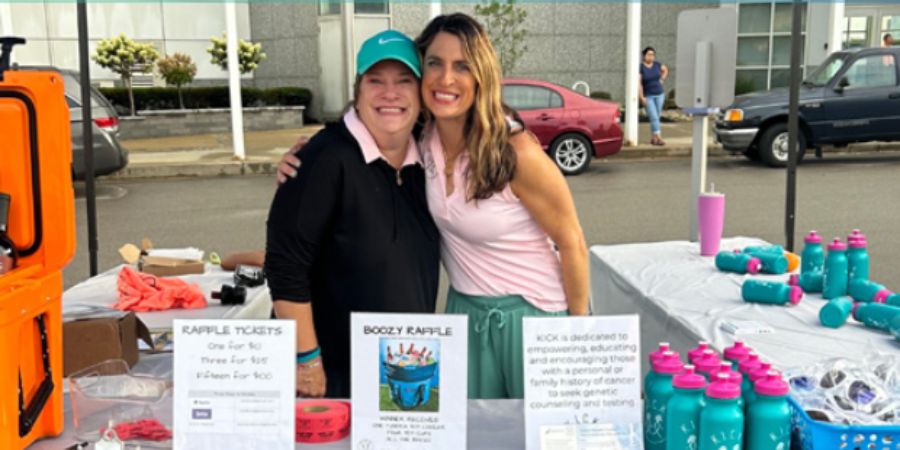
Knowledge Is Cancer’s Kryptonite (K.I.C.K.) was founded in 2023 and has since facilitated genetic testing for over 300 patients across 48 states. By collaborating with genetic counselors, K.I.C.K. can offer financial assistance for tests that enable patients to make informed choices after comprehending their cancer risk.
Colleen expressed her views on moving past the fear of understanding one’s risk levels. “The most important lesson I’ve learned is – my sister and I are here today and can hopefully grow old with our husbands and children because of this. Our aunt didn’t have that opportunity. Discovering one’s risk can be a source of fear for many, and I understand that, but knowledge can be life-changing.”
Through their advocacy, K.I.C.K. has also teamed up with OutRun Ovarian Cancer (OROC), a Northeast Ohio-based nonprofit committed to raising awareness and funds for ovarian cancer. Since its inception in 2003, OROC has raised over $2,000,000. Each year, OROC organizes events and fundraising activities to support survivors and honor the memories of those lost, particularly at an annual 5K Run/Walk event in downtown Cleveland. OROC held its 22nd annual 5K Run/Walk on August 2nd, 2025, attracting more than 1,400 participants.
K.I.C.K. and OROC’s missions are inherently aligned, and through their collaboration, both organizations encourage those at hereditary risk for cancer to seek testing and be empowered by knowledge. Colleen and Katie attend the annual race to provide support and encouragement to survivors and their families. At one of the OROC 5K events, Colleen recalls being touched by a patient who had traveled to thank her for the help she received from K.I.C.K. “It was an incredibly emotional moment for everyone involved,” she shared.
**Empowering Families in Cancer Care: The Role of K.I.C.K. and OROC in Providing Knowledge and Support**
Cancer is a transformative diagnosis that impacts not only the individual but also their families. The emotional, physical, and financial strains can be overwhelming, making supportive networks essential for managing the intricacies of cancer care. K.I.C.K. (Knowledge, Information, Community, and Kindness) and OROC (Oncology Resource and Outreach Center) are two organizations that play crucial roles in empowering families through education and support.
### K.I.C.K.: A Community-Focused Approach
K.I.C.K. is committed to equipping families with the knowledge and resources they require to comprehend cancer and its treatment alternatives. The organization emphasizes four main components:
1. **Knowledge**: K.I.C.K. provides educational workshops and seminars facilitated by healthcare experts. These sessions address various topics, including types of cancer, treatment options, and coping mechanisms. By clarifying medical terminology, K.I.C.K. assists families in making well-informed care decisions.
2. **Information**: The organization offers a wealth of resources, including brochures, online articles, and support groups. Families can access information tailored to their unique circumstances, whether they need advice on nutrition during treatment or insights on chemotherapy side effects.
3. **Community**: K.I.C.K. cultivates a sense of community among families affected by cancer. Support groups and social events enable families to connect with others who share similar experiences. This network provides not only emotional support but also opportunities for exchanging practical advice and resources.
4. **Kindness**: Acknowledging the emotional weight of a cancer diagnosis, K.I.C.K. prioritizes kindness in its approach. Volunteers and staff are trained to deliver compassionate support, ensuring that families feel valued and understood throughout their journey.
### OROC: Bridging Gaps in Cancer Care
OROC complements K.I.C.K.’s initiatives by concentrating on outreach and resource availability. The organization seeks to close gaps in cancer care, especially for underserved populations. Key initiatives include:
1. **Resource Distribution**: OROC supplies vital resources such as transportation aid, financial assistance for medical expenses, and access to clinical trials. By removing logistical obstacles, OROC helps families focus on treatment and recovery.
2. **Advocacy**: OROC pushes for policy reforms that enhance access to cancer care. Collaborating with healthcare providers and policymakers, the organization aims to foster a fairer healthcare system for all families facing cancer.
3. **Training and Workshops**: OROC provides training for healthcare professionals to deepen their understanding of the unique challenges families encounter in cancer care. This initiative promotes a more empathetic and informed patient care approach.
4. **Cultural Competency**: Recognizing the diverse backgrounds of cancer patients, OROC emphasizes cultural sensitivity in its programming. This focus guarantees that families receive care respectful of their cultural values and practices, fostering an inclusive atmosphere.
### The Synergy of K.I.C.K. and OROC
Together, K.I.C.K. and OROC form a holistic support system for families managing cancer care. By integrating education, resource accessibility, and community engagement, these organizations empower families to take an active role in their care journey.
Families that engage with K.I.C.K. and OROC report feeling more informed, supported, and connected. This empowerment not only enhances their ability to confront cancer’s challenges but also cultivates resilience and hope.
### Conclusion
Navigating the cancer care journey is undoubtedly challenging, but organizations like K.I.C.K. and OROC are making a meaningful difference by empowering families through knowledge and support. By prioritizing education, resource accessibility, and community connections, they are transforming the cancer care experience, ensuring that no family has to embark on this journey alone.