Ruth Chan is a Brooklyn-based illustrator living with her family. She creates and illustrates children’s books. For Cup of Jo, Ruth has explored subjects including pets, grief, OCD, moments of connection, and baby wonder. Also, check out her beauty uniform and favorite public crying spot. xo
P.S. Memories of Lunar New Year, plus an eight-minute film that moved us to tears.
**Honoring Lunar New Year with a Lion Dance**
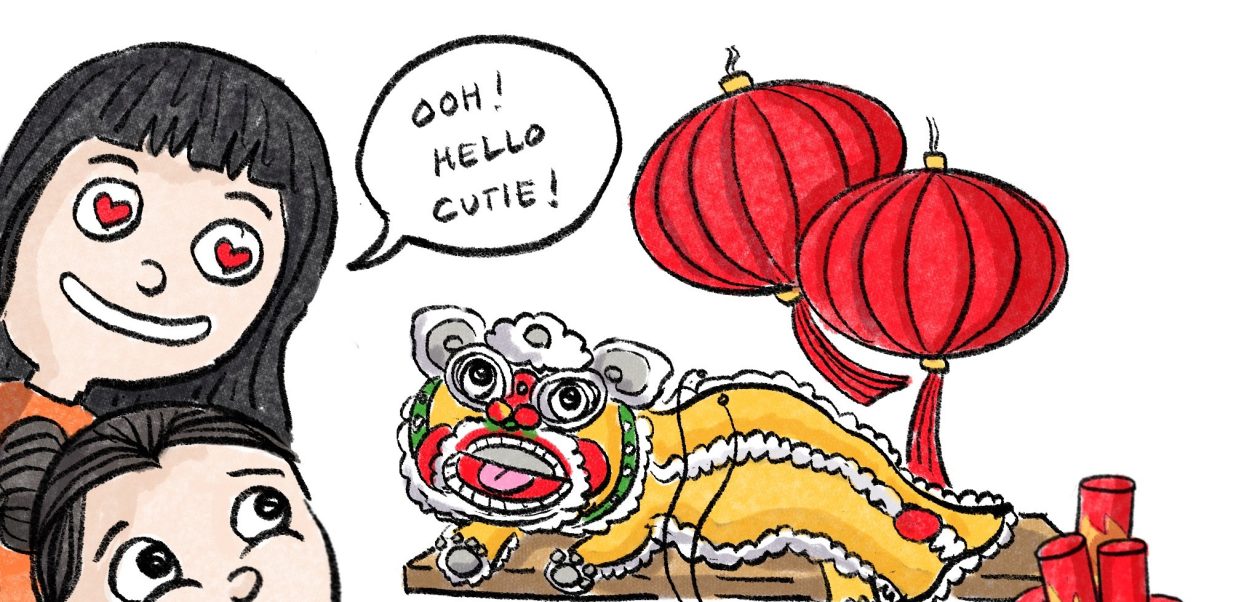
The Lunar New Year, or Spring Festival, is among the most important festivities in many Asian traditions, signaling the onset of a new year following the lunar calendar. Of the numerous customs and celebrations linked to this occasion, the lion dance is notable for its lively and emblematic performance that enthralls spectators with its vigor and artistry.
**Historical Roots and Meaning**
The lion dance boasts a long history spanning over a millennium, with its beginnings grounded in Chinese folklore and legends. It is thought that the dance was devised to repel evil spirits and invite good luck, wealth, and joy for the forthcoming year. The lion, representing power, intelligence, and good fortune, is an auspicious entity in Chinese tradition, notwithstanding its non-native status in China.
**The Presentation**
An authentic lion dance features two performers within a lion outfit—one maneuvering the head and the other the tail. The artists need exceptional skill, as the dance demands a blend of martial arts, gymnastics, and meticulous choreography. The lion’s actions are harmonized with the sound of drums, cymbals, and gongs, forming a lively and rhythmic display.
The dance frequently incorporates light-hearted and dramatic exchanges with spectators, highlighting the lion’s character, which can vary from inquisitive and playful to bold and regal. The lion may also engage in complex feats like hopping onto tall platforms or balancing on poles, showcasing the performers’ dexterity and strength.
**Diverse Cultural Expressions**
Although the lion dance is mainly linked with Chinese tradition, it is also executed in other Asian nations with their distinct forms. In Vietnam, for instance, the lion dance is termed “múa lân” and plays a crucial part in Tết festivities. In Malaysia and Singapore, the dance is a multicultural event, mirroring the varied communities celebrating the Lunar New Year.
**Significance of the Lion Dance in Celebrations**
Throughout the Lunar New Year, lion dance troupes are invited to appear at various functions, such as parades, temple fairs, and private gatherings. Businesses frequently organize lion dances to draw in clientele and bless their venues with good fortune for the upcoming year. The dance is also a central element of community celebrations, uniting individuals to enjoy the holiday’s joy and excitement.
**Summary**
The lion dance transcends a mere performance; it is a revered cultural practice that represents the essence of the Lunar New Year. Its vibrant exhibition of color, sound, and motion serves as a reminder of the values of unity, prosperity, and renewal. As families and neighborhoods come together to honor the Lunar New Year, the lion dance remains a key component in preserving cultural traditions and spreading happiness and good fortune.