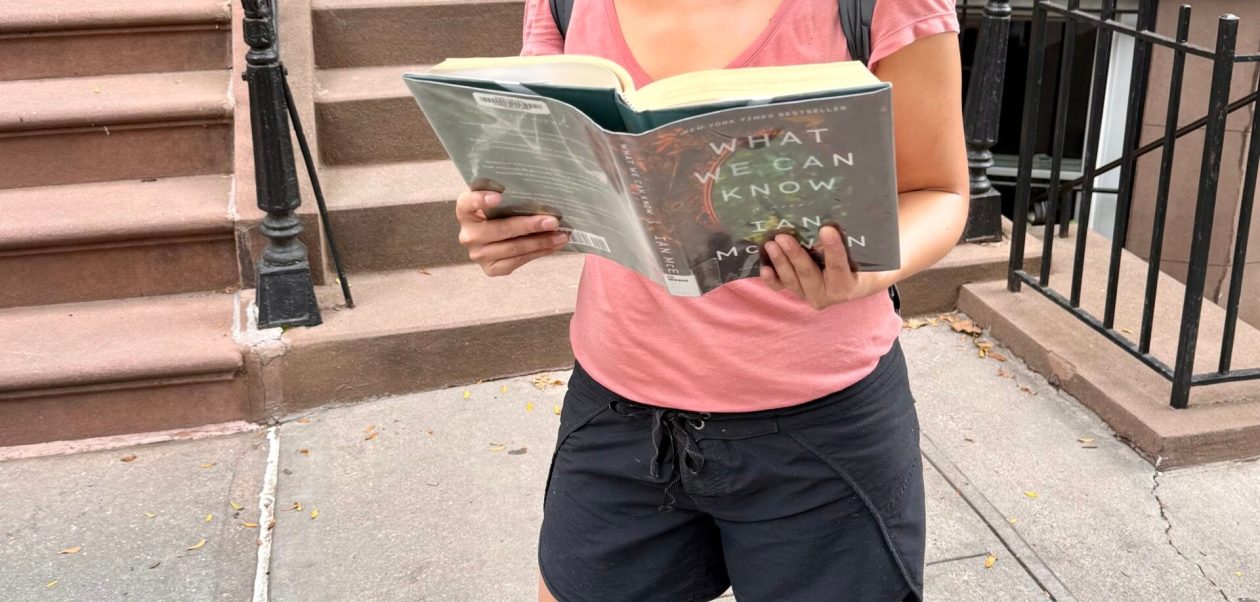
This morning, my brother and I went out for coffee and encountered a woman who was calmly engrossed in her book as she walked down the street. While many people check their phones while strolling, lately I’ve noticed women opting to read books instead. Intrigued, I decided to chat with her. Her name is Stephanie, and she’s an educator residing in Brooklyn. Here’s what she shared with me…
Where are you heading right now?
I’m doing some errands, followed by a visit to the library.
Do you regularly read while walking?
I started this habit quite some time ago. After college, I was living in Brooklyn and working in Manhattan. To economize, I’d walk across the Brooklyn Bridge. Reading became a way to occupy myself during the walk. I also tend to get restless just sitting with a book at my place.
Do you ever bump into things?
I’m not flawless, so occasionally I might collide with a stray branch. But mostly, I take the same route, so I’m well-acquainted with it. People on their phones often nearly crash into me, rather than it being the other way around!
What book are you reading?
What We Can Know by Ian McEwan. The narrative features an academic studying a poem recited at a dinner in 2014, as he delves into finding the unpublished piece and its context. Midway, the perspective shifts to the poet’s wife, revealing the true events.
What other books have you loved?
Honey in the Wound by Jiyoung Han, an intergenerational tale combining fantasy and history. The Storm We Made by Vanessa Chan. Though the novel is profoundly tragic, her festival talk a few years back was humorous. I also adored The Wedding People!
Do you walk like this in the winter, too?
The chill makes it challenging, but I double up on gloves, and my aunt got me rechargeable hand warmers for Christmas.
I noticed it’s a library book.
I reside in a studio apartment, limiting my space for books. I frequent my local branch, consistently placing holds on titles.
Have you always loved reading?
Indeed, and I pursued linguistics in my studies. I now teach ESL at a high school for immigrant students. I was born and raised here, yet my parents are immigrants, so I empathize with some challenges. I consistently encourage frequent reading.
Thank you so much, Stephanie!
P.S. How do you get out of a reading slump, and what nonfiction books do you love?
**The Practice and Implications of Reading While Walking**
Integrating reading with walking, frequently witnessed in bustling cities and tranquil parks alike, merges two distinct activities into one seamless motion. This dual-tasking habit may not be common universally, but it captivates psychologists, urban planners, and safety experts due to its effects on cognition, safety concerns, and urban design.
**The Cognitive Aspect**
Reading on the move requires a distinctive cognitive ability to absorb information from a book or device while navigating surroundings simultaneously. This dual engagement activates both the brain’s visual and motor systems, demanding substantial concentration and spatial awareness. Research indicates that individuals who habitually read while walking may develop enhanced multitasking capabilities, as their brains adjust to processing two streams of information at once. However, this practice can also lead to cognitive overload, where the brain struggles to manage both tasks effectively, potentially diminishing comprehension and retention of the reading material.
**Safety Concerns**
A primary consequence of reading on the move is the accident risk. Pedestrians absorbed in a book or screen might become unaware of their surroundings, increasing chances of collisions with obstacles, other pedestrians, or vehicles. This behavior resembles the hazards associated with texting while walking, prompting some cities to introduce measures such as designated “texting lanes” or fines for distracted walking. Safety experts advocate for heightened public awareness campaigns to emphasize risks tied to this behavior, urging pedestrians to focus on their surroundings over reading.
**Impact on Urban Design**
Urban planners are increasingly accounting for reading on the move in public space designs. The rise of mobile technology and e-readers simplifies this habit, urging cities to rethink pedestrian pathways. Broader sidewalks, pedestrian-only zones, and strategically placed benches and rest areas can accommodate those who wish to read without hindering foot traffic. Moreover, incorporating tactile paving and audible crosswalk signals can enhance safety for distracted pedestrians.
**Cultural and Social Considerations**
Reading while walking also reflects broader societal and cultural patterns. In fast-paced societies, the desire to maximize productivity and efficiency often results in combining activities. This behavior echoes the modern “always-on” mentality, where downtime is minimized in favor of continuous engagement with work or leisure activities. However, this trend raises questions about the quality of engagement with reading material and the potential loss of the immersive experience that comes with focused, uninterrupted reading.
**Conclusion**
While reading on the move might offer certain cognitive benefits and reflect modern cultural practices, it also presents notable safety risks and challenges for urban design. As cities continue evolving and adapting to residents’ needs, balancing accommodating this practice with ensuring public safety will be essential. Promoting mindful engagement with both reading and walking, possibly by designating reading areas or advocating for periodic breaks, can help mitigate risks while preserving the joy and utility of both activities.