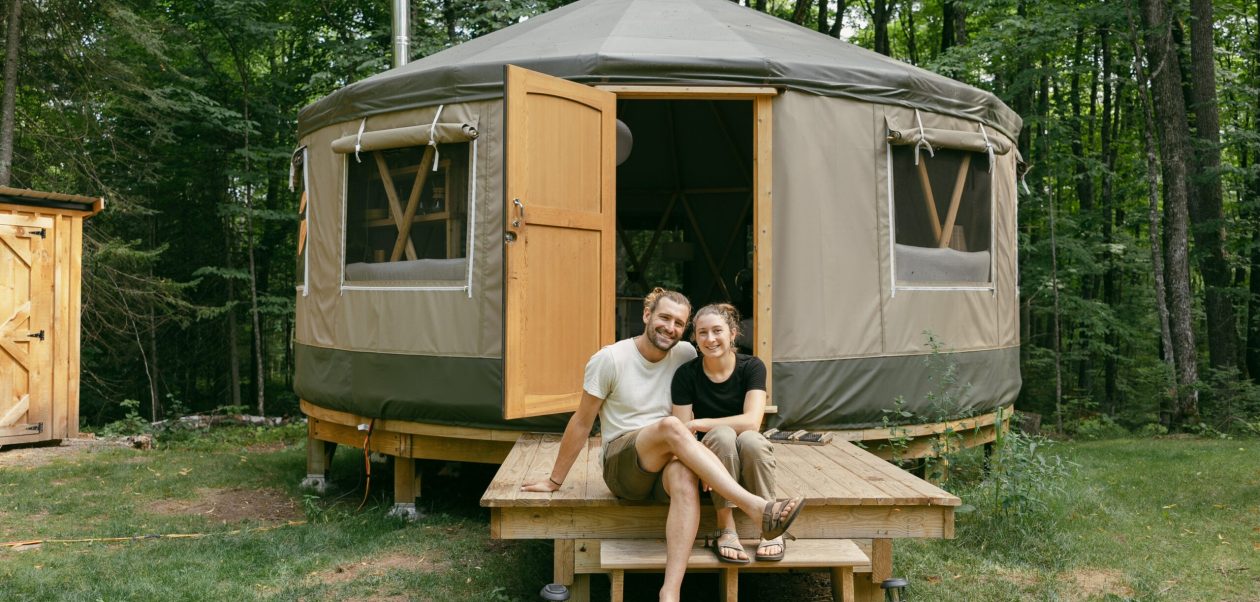
“There wasn’t a significant aha moment,” shares Elaina Jindra, a public school dean residing in a 350-square-foot yurt alongside her husband, Zach, in rural northern Wisconsin. “Gradually, we became intrigued about what life might be and desired a fresh experience.” Presently, Elaina guides us on a tour with photos by Xee Vang…
On switching things up: Zack and I resided in a house in Milwaukee, when we realized we were at a point in our lives where we could move and try something new. Thus, we left our jobs, got rid of 65% of our belongings, and listed our house for sale.
Dining table and chairs: thrifted.
On opting for the yurt: We weighed options like relocating abroad, acquiring a tiny home, or residing in our Subaru Outback, but ultimately, living in a yurt seemed the simplest and most economical choice. Tiny homes can be pricey, require more time to establish, and have utility costs. A yurt is available in a DIY kit which was set up in a day.
Sofa: Crate&Barrel. Light pendant: “I crafted this pendant using an old shade from a Target lamp received as a wedding gift.” Basket: World Market. Desk: vintage.
On planning: It took 15 months to locate land without county regulations, as these typically require multiple building permits. Before officially purchasing the land, we were here outlining the yurt’s size with footsteps in the snow and measuring each piece of furniture we planned to bring.
Stove: Ace.
On yurt essentials: Surviving in a Wisconsin yurt without a wood stove is difficult. Also, candles are a must. Cozy, warm lighting is essential.
On local wildlife: While in the yurt, you can hear everything. Spring peepers and loons are incredibly noisy. An owl often settles nearby hooting through the night. We hear howls from a local wolf pack. Peaceful evenings as we imagined are rare here! Yet hearing wildlife is wonderful.
Bed: West Elm. Throw pillows: crafted by Elaina. Rug: thrifted.
On mindful choices: Many yurts have tight lattice with a vinyl interior preferred for durability and longevity. Our choice was a yurt with large lattice and wool interior. It’s aesthetically nicer. We also want portions of the yurt to decompose to leave a smaller footprint.
On living without Wi-Fi: Although without Wi-Fi, we have excellent cellphone service for contacting family and friends. We also reside three miles from a trailhead with great Wi-Fi, vending machines, and good vibes. Zach is a wedding photographer, so the trailhead is convenient for editing and uploading galleries.
On a clever meal trick: To clean out the fridge, I collect leftovers and create a pizza. It’s called ‘garbage pizza’ inspired by Anne-Marie Bonneau, the Zero Waste Chef. I’ve been fascinated with her since college. She encourages creative ways to consume every item in the fridge rather than discarding them.
On a revealing habit: A few years back, Zach and I began tracking our time and financial expenditures. At each month’s start, I presumed my spending would be minimal since ‘I never purchase anything.’ However, month’s end proved otherwise. Now we consciously avoid unnecessary purchases.
On new routines: Out here, tasks take longer. At times, following a lengthy workday, I’m reluctant to handle dishes, then transport and empty our seven-gallon waste jug outside. Tasks at inconvenient times can be irksome. We expected these trade-offs beforehand, hence try not to complain.
TK WORK BLURB
The yurt in winter.
On winters: Winter is our beloved season for its coziness. Last year, temperatures dropped to negative 30s. But we simply maintained the wood stove
On newfound insights: Zach and I married at 23 — so young. I feel fortunate since, though we were unaware of our identities then, we’ve grown splendidly together. Our life here wouldn’t be feasible without his belief and optimism towards living happily in a 350-square-foot abode. He encourages me to step out of comfort zones.
Sauna: SaunaLife.
On a wood-fired sauna: Rarely in summer but adore using it in winter. It’s our prime move when entertaining friends.
On off-grid living: Utilizing a solar generator powered by solar panels ensures electricity flow. A gas generator is backup, used every three to four days during winter. Yet, in case of failures, we’re fine. Both avid backpackers, accustomed to going days without hot water or power.
Shower: Amazon. Outhouse: “Locally built by Amish community members.”
On showers: We have a solar shower for summer use. The rest of the year, we shower at a gym. A gym membership is a smart minimalist tip, close by with necessary amenities. We frequently visit at day’s end and have built camaraderie with the staff.
Yurt: Yurta.
On various reactions: Responses upon learning about our lifestyle vary. Some ask, ‘You know, you’re not obligated to live that way, correct?’ or ‘If necessary, I can assist.’ Others exclaim, ‘Oh my god, so cool!’ seeking every detail.
On major discoveries: Living here clarified needed resources for thriving, not just surviving. We learned not much is needed. Grateful for the opportunity to explore. Sustainability was a motivator, but also desired slowing down. Observing wind and moon phases.
Thank you so much, Elaina!
P.S. Many more house tours, an architect couple’s spaceship apartment and a 175-square-foot NYC apartment (“I call it ‘my room’”).
(Photos by Xee Vang for Cup of Jo.)